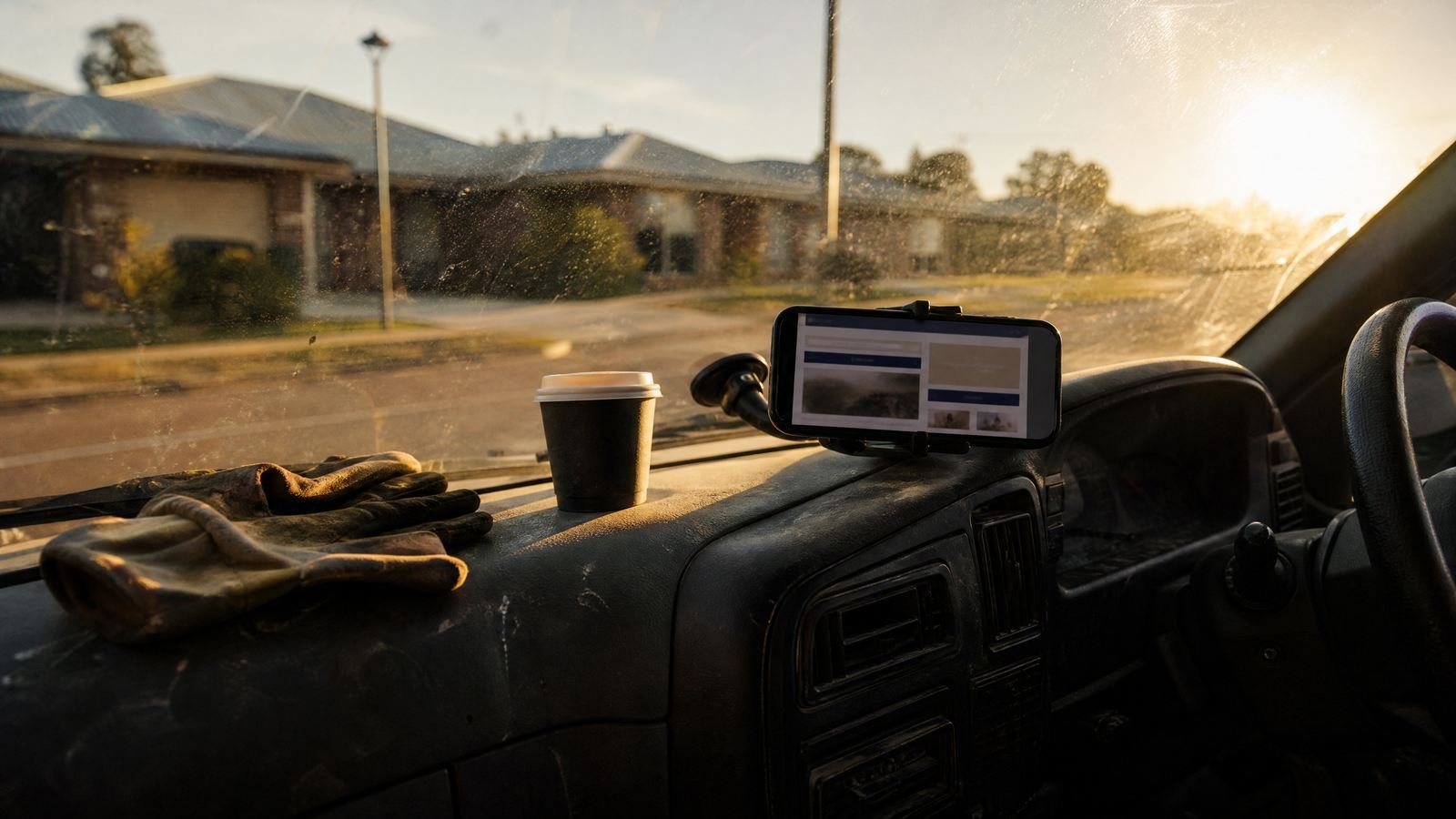
Tradie website build
Found on Google. Named by AI.
It starts with a website that’s actually about your work. If yours says quality workmanship, competitive prices, no job too small, Google can’t tell you apart from anyone else, and neither can an AI assistant.
So we build around the jobs you’ve really done and the suburbs you really cover. And the domain and the hosting go in your name before we write a word.
Free check
See where you turn up when a customer searches your trade in your suburb.
Nothing here gets written until we know who you’re selling to, what the other operators in your patch already say, and what you can say that they can’t. You get that in writing before a page gets built.
That work is what decides whether you get named. When someone asks the whole question instead of typing “plumber Coorparoo”, Google often puts an AI answer above the results. Pew Research Center (22 July 2025, US data) found that searches phrased as a question returned one of those AI answers 60% of the time, against 8% for one- or two-word searches. When that answer appeared, people clicked through to a website on 8% of visits instead of 15%.
So the job is being the source the answer gets built from, and that comes down to what your site says about your actual work — not how many times it repeats a keyword. If someone’s quoting you on getting to the top for a keyword, ask them what happens when the answer is written before anyone scrolls. What that means before we start.
You paid for a website. It isn’t bringing you work.
It looks alright. It went live, you paid the invoice, and then nothing changed. The phone rings the same as it did before, and the jobs still come from the same three blokes who always refer you.
Here’s why. The 5 pages on it say the same 3 things: quality workmanship, competitive prices, no job too small. Swap your logo for the concreter’s up the road and every word still reads true. Nothing on it could only be about you, so there is nothing for Google to rank you on and nothing for an AI assistant to quote.
And it doesn’t name a single suburb you actually drive to. Somebody two streets from your last job could search for your trade this morning and get three other names.
Then you go to fix it, and find you can’t. The mobile number on the contact page is your old one. You emailed the mob who built it in March and nothing came back. The domain renewal invoice arrives from them, not from the registrar — so it isn’t really your domain. It’s theirs with your name on the front.
A site that says nothing specific can’t be found, and a site you can’t get into can’t be fixed. So we hand you the keys first, and build something only you could have said second.
Free tool — no email needed
Before you spend anything, find out where you actually stand
The online presence check looks up your trade in your suburb and shows you what a customer sees: your map position, who is sitting above you, which directories outrank your own website, and whether an AI assistant can find a reason to name you. The result is on your screen and it does not ask for an email.
Or ask for the free audit: a person looks and emails you what to fix first within a business day.
Free. 2 minutes. No call unless you ask for one.
We never share or sell your details, and we do not add you to a mailing list.
What it does for you
Four things a template site can’t do
This is what the money actually buys. Not pages, not a design — these four.
You turn up where the work is
Real location pages built out of jobs you’ve actually done, inside the patch you actually work — one on Regional, six on Suburban, twelve on Metro. Not 25 pages with the suburb name swapped and everything else identical — the pattern Google’s own spam policies call scaled content abuse, defined there as many pages made to move rankings rather than help anyone.
An AI assistant can find a reason to name you
AI assistants quote what they can read. “Quality workmanship” gives them nothing to quote. Your licence number, your suburbs, your insurance and a real job you did there give them something to point at when a customer asks who to call.
You can walk out any time you like
The domain and the hosting sit in your name from day one, on your card, in your email. If we stop being worth the money you take the lot and go, and you don’t have to ask us for anything to do it.
You get proof, not promises
Every page is checked before it goes live, and you’re handed the results for every page, warnings included. You can hold the next builder to the same standard.

How we build a tradie website that gets found
7 steps. There’s no stage where you wait a fortnight wondering what we’ve been doing.
1
The domain goes in your name
Your registrar account, your email, your card on it. Not ours with your business typed into a box. If you already own the domain we never touch the registrar — we tell you exactly which 2 records to change and you change them yourself.
Hosting works the same way: your own account, in your name. If you want to log in and edit pages yourself, say so and we build it on WordPress.
2
One set-up list, done together, with a date on it
Every build needs a handful of things only you can give us: logins, your licence and insurance details, photos, who signs off. They all go on one list, and we sit down with you for a short session to go through every item, explain what it is for and fill in as much as we can on the spot.
The rest you finish on your own time, by a date we agree in that first session. A second session on that date rounds it up. If anything is still missing after that, you know exactly what it is and that it is the one thing the build is waiting on.
3
15 minutes on the phone, recorded
Not a form to fill in. 9 questions about your actual work: a job in that suburb you’d still remember, what makes the work harder there, the 5 questions you get asked on every site visit, and the job you turn down.
Anyone can look up your competitors. Nobody else knows what you did in Thornlie last month.
4
Your pages get chosen for your business
Home. One page for each service you genuinely do differently, not one per task. A service-area page naming the suburbs you actually cover, never “we service everywhere”. FAQ. About, carrying your licence number, your insurance and your years on the tools. Terms, privacy, contact.
That’s a starting shape, not a mould. If you sell to homeowners and to facility managers you get 2 separate service sections, because those are 2 different buyers who need to hear 2 different things.
5
The build runs while you’re on the tools
Two weeks on Regional, three on Suburban, four on Metro, and the clock starts when everything is in. We won’t promise same-week. If someone else does, ask them what gets skipped.
Send us your job photos and we handle the rest of it. That includes telling you when a video is too big for the page, instead of quietly putting it up and slowing your site down.
6
Every page gets checked before it goes live
Every page gets checked against what Google and the AI assistants actually reward right now — including whether they’re allowed to read your site at all. Miss that and you can be invisible to ChatGPT while showing up fine on Google.
Then a second check runs across the whole site at once, not just the new pages, to catch any 2 pages saying the same thing in different words. Anything that fails gets rewritten before it goes live, not after you’ve noticed.
7
You get the keys, and the proof
Logins to the domain and the hosting, the site’s files, and the check results for every page, warnings included.
After it goes live, we check the live site against what we built, so what’s live is what you paid for. No carousels, no sliders, nothing that only exists to look busy on a demo.
Before you go any further
Who this is for, and who we turn away
We build for one trade per service area, so it’s worth telling you now who we turn away, rather than after you’ve filled in a form.
This is you
- You work a patch you could drive across in under an hour.
- You’ve got finished jobs you can talk about for 15 minutes.
- You want the domain in your own name, and you’re willing to hold it.
- You’re weighing up two or three quotes and want to know what actually differs.
- You’d rather be told the cheapest option is wrong for you than be sold it.
If that’s you, the free check is the whole first step. It takes 2 minutes and nobody rings you.
This isn’t you
Your patch is already taken. One trade per service area, and we don’t bend it. If someone in your trade two suburbs over is already with us, the answer is no — and we tell you that before you’ve spent anything.
You need a whole capital city on the $4,997 build. It won’t do that. Metro will. If your market is bigger again, we’ll say so instead of taking the money.
You want to edit pages yourself. Our standard build is made to load fast and has no editor to log into. Say so before the build and we’ll put you on WordPress instead, which trades a bit of speed for one.
You want to hand it over and never think about it. The 15-minute call isn’t optional. Without your jobs in your words, we’re building the same template everyone else got.
Three builds. What each costs, and what each locks.
Every tier, every number, and exactly what “exclusive” means. The free audit tells you which one fits — and it will tell you if the cheapest one isn’t it.
Regional
$2,997
One town, one trade, done properly. For the patch where the problem is that nothing about you is online yet.
- 3 service pages, 1 location page, 12 blog posts
- 25 pages all up, including the nine core pages
- Live in 2 weeks once everything is in
- 50% deposit, 50% on completion, before it goes live
- Your town, first refusal for your trade
- Your first month on Stay Found included
One town
Suburban
$4,997
The flagship, not the middle option. A patch you could drive across in under an hour — and then those suburbs are yours.
- 6 service pages, 6 location pages, 21 blog posts
- 42 pages all up, including the nine core pages
- Each location page carries a local specific and a real job you did there
- Live in 3 weeks once everything is in
- 25% deposit · 50% on draft approval · 25% before it goes live
- Your suburbs, first refusal for your trade
- Your first two months on Stay Found included
Our default build
Metro
$7,997
A whole city market a radius can’t cover. Not sold as an upgrade. If your city is bigger than this, we say so instead of taking the money.
- 12 service pages, 12 location pages, 39 blog posts
- 72 pages all up, including the nine core pages
- Live in 4 weeks once everything is in
- 25% deposit · 50% on draft approval · 25% before it goes live
- The metro, first refusal for your trade
- Your first three months on Stay Found included
Whole-city markets
The monthly work starts included. One month on Regional, two on Suburban, three on Metro, from the day the site goes live: the monthly check against your live site, the one-page report in plain English, the Google Business Profile work, and your first new pages written off jobs you have actually finished. There is still no contract attached to the build — at the end of the included run you decide whether to keep going, and we tell you the date before it arrives. Want Hold Your Patch from day one? You pay the $700 a month difference during those included months.
Your licence number, your ABN and a privacy policy are on the site when it goes live. A customer checking you out looks for all three.
First refusal comes with every build. From the day your site goes live, if someone else in your trade asks us to work in your area, you hear first and get 14 days to move onto Hold Your Patch before we quote them. Hold Your Patch is what locks it.
Outgrow the one you picked and you pay the difference. We will not talk you up a size to begin with, and the Metro build is not sold as a step up from Suburban. But work grows, and if yours grows into a bigger patch later, the extra service and location pages get researched and built the same way the first set were. Nothing you have already paid for is thrown away, and nothing already on the site gets rebuilt.
Exactly what “locked” means — before you ask
- Your build earns the ground. Regional earns your town, Suburban earns your suburbs, Metro earns your trade across the whole metro.
- Hold Your Patch is what keeps it shut. While you are on it, we will not build another business in your trade inside that ground. Stay Found keeps you where the build put you; it does not hold the patch.
- No overlap, ever. A Metro build blocks patch builds for that trade in that city, and a patch build blocks a Metro build for that trade in that city.
- If you stop, we keep your patch shut for 90 more days. You don’t pay for those 90 days and they aren’t in any contract. We keep turning your competitors away because you were a client, not because you owe us anything.
- Inside those 90 days you get the email before they get a quote. If someone in your trade asks us to build inside your suburbs, you hear about it first and you have 14 days to come back on at the price you were paying. Only if you don’t do we build them.
- After 90 days the patch is open, and we’ll say so plainly.
- Come back after that and the patch is re-earned at what it costs then, not at what it cost you. That’s the only penalty.
- If your patch is already taken, you find that out before any money changes hands.
Why we can’t take it off you even if we wanted to
The domain is in your name from day one. Everything the site earns with Google and with the AI assistants — the pages, the history, the reason either of them trusts you — lives in that domain and walks out with you. There is no account of ours to close and no credibility of ours to withdraw, because none of it was ever ours.
Which means the bloke we build after you doesn’t inherit anything. He starts at nothing, against a site you spent a year in front of him with. The day you stop, nothing happens. Twelve months later, someone who didn’t stop is where you were. That is the whole of it, and it is the reason to stay — not a clause.
You will not notice in the first month. Nothing falls over, the phone rings the same, and the decision looks free. You notice somewhere around month three — and when you do, it’s easy to blame the season, or the weather, or the fact that everyone goes quiet in January. Sometimes that’s exactly what it is.
Sometimes it isn’t. That’s why we leave the door open for 90 days instead of closing it the moment you stop.
What you get on all three
- The domain and the hosting in your name from day one
- Hosting is about $80 a year, paid by you, straight to the host. We don’t mark it up and we don’t resell it — if that bill came from us, you’d be renting your own website
- A 15-minute recorded call, so the words come out of your work and not a template
- Every page checked before it goes live — and re-checked as Google and the AI assistants change what they reward
- No page goes live if it fails the check — and you see the results
- No contract after handover. Nothing recurring unless you ask for it
Not registered for GST. The price you see is the price you pay.
Free check: 2 minutes, no email, the result on your screen. The free audit tells you which build fits.
What happens next
1. Ask for the free audit. It takes 2 minutes and nobody rings you.
2. Within a business day we email you where you’re actually turning up, who’s above you, and which of the three fits — with the reason.
3. If it’s a yes, the deposit and the 15-minute call get booked in the same week.
4. Two to four weeks after everything is in, depending on the build, you get the keys, the site’s files and the check results.
Why 6 location pages beats 25
Google’s spam policies name this one: scaled content abuse, many pages made to move rankings rather than help anyone. The test is one you can run on your own site tonight: take the suburb name out of a page. Does anything else on it have to change?
A set of pages whose only unique term is the suburb name fails that check. A set built from real jobs passes it. A handful of pages that could only be about your work isn’t a smaller product than hundreds of interchangeable ones. It’s the one that’s still there next year.
Done by a person
Your enquiry form goes in pointed at your own inbox, and a person sends a test enquiry through it and watches it land before you’re handed anything.
Same with Google Business Profile posts if you take a retainer later: we write them, a person publishes them. You see each one first.
Fifteen at a time
We take fifteen monthly clients at a time. That is how many patches we can hold shut and still do the work properly. When it is full we say so, before you spend anything.
What you are risking before you have seen anything
On the two bigger builds you pay a quarter to start. Then you see the real pages — your jobs, your suburbs, your words on them — and the rest of the money only moves once you have. On a $4,997 build that is $1,249 in before anything is on a screen.
- The domain, the hosting account, the site, every page and every file are in your name from day one. There is no account of ours for you to be locked out of.
- Your current website stays up and untouched until the day the new one goes live.
- Nobody owns where Google puts you, so nobody can promise you a spot on it. If someone does, ask them what happens to your money in the month it does not land. What you get here instead is the same measurement we get, every month: where you come up, who is above you, and whether the assistants name you when a customer asks who to call.
Take these to whoever else is quoting you
Six questions that sort the builders from the sellers
You should not have to take our word for any of this, so here is what to ask — of us and of everyone else. We have put our own answers underneath each one. If somebody dodges three of these, you have learned something worth more than a quote.
01
“Whose name will the domain be registered in?”
Ours: yours, on your card, in your email, before a line of the build starts. If the answer is anything else, you are renting your own business — ask to see the registration record before you pay a deposit.
02
“Can I see how every page was checked?”
Ours: every page is checked before it goes live, no page goes live if it fails, and you get the results with the warnings left in. Ask for the same from anyone else.
03
“Can I change my own phone number after launch?”
Ours: on our standard build, no — you send it to us and we change it, usually same day. Say so before the build and we put you on WordPress instead. If someone says “yes, easy”, ask them which platform it’s on.
04
“What can’t you do?”
Ours: we can’t promise where Google puts you, and we won’t build for two businesses in the same trade and patch. If the answer is “nothing”, ask again.
05
“If I leave, what do I walk out with?”
Ours: the domain, the hosting, the site’s files and the check results. No contract after handover. Ask what goes dark the day you stop paying — if the site does, you never owned it.
06
“How many pages, and how long will it take?”
Ours: 25, 42 or 72 pages depending on the build, and four weeks at the outside once everything is in our hands. Whatever the number, ask to see two of the suburb pages side by side and read both — one template with the suburb name changed can count as sixty pages and read as one.
We would rather you asked all six and picked somebody else than skipped them and picked us.
The price is printed before we start
Every build has its price on the pricing page. No hourly rates, no invoice you did not see coming.
Everything goes in your name
The domain, the hosting and the site’s files. If you leave, you walk out with all of it.
No contract after handover
The build is paid and it is yours. Monthly work runs month to month on 30 days’ notice.
Questions people actually ask before they book a build
How much is a website?
Who owns the domain and the hosting?
How long does it take?
Do I have to pay the whole lot upfront?
Can I change the phone number myself afterwards?
What’s the actual difference between $4,997 and $7,997?
I’m in a capital city. Does the $4,997 one work here?
Does the contact form actually work?
What do I actually get handed at the end?
What happens after it goes live?
If I stop paying monthly, do you sell my patch to a competitor?
What do I actually lose if I walk away?
I already have a website. Do I have to start again?
Do you do the Google Business Profile as well?
Keep reading
Three things tradies must know before committing to a website build.
The pitfalls you don’t know you don’t know. Each one is a quick read, and each one is worth more than the ten minutes it costs you.
7 min read
Who actually owns your website? Here’s how to check in 5 minutes
Read the public domain record, find who your hosting invoice really comes from, and test whether you hold a login that can change your own phone number.
7 min read
The pages a trade website actually needs, and the ones that pad the invoice
The pages that earn their place on a trade website, what each must carry, the 7 that only pad the invoice, and 4 questions to put to any quote.
7 min read
What you should be handed on launch day
The 9 things a finished build owes you: 4 logins in your name, a dated copy of the files, the check results with the warnings intact, and a tested enquiry form.
Know which website you actually need, before you chase the cheapest quote
The free audit looks at your business, in your suburb, and within a business day we email you what’s missing and which build fixes it. Free, and nobody rings you.
One trade per area. If your patch is taken, we’ll tell you that instead of selling you a build that has to fight it.