Tradie content
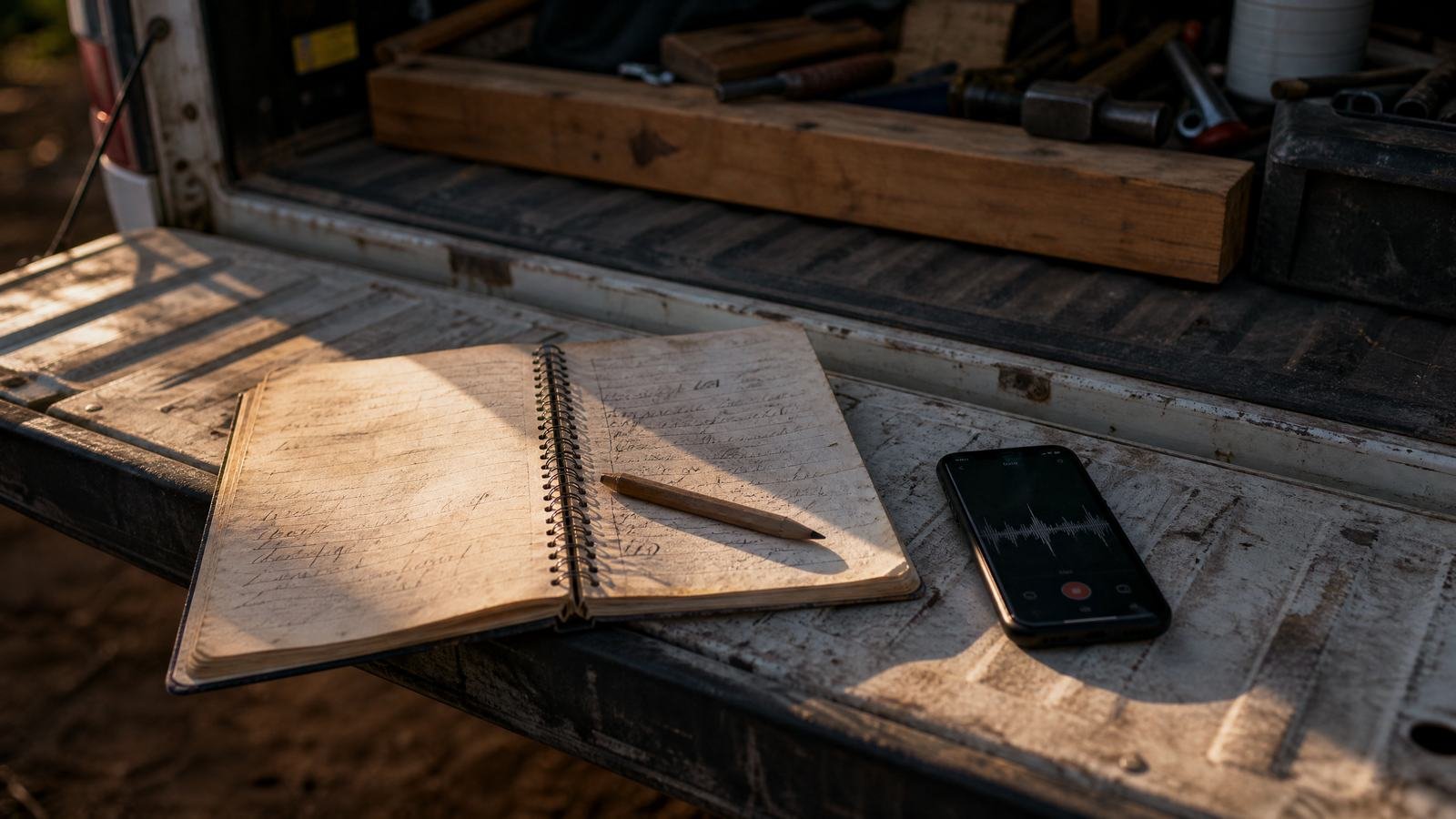
You don’t write a word. You talk about jobs you’ve already done, and we build the page from that.
One conversation a fortnight on Hold Your Patch, one a month on Stay Found. The suburb, the fault, the fix, what it cost you. That becomes a new piece on your site, checked against every other page you own before it goes anywhere. It sits in both retainers — a page a month on Stay Found at $1,297, a page a fortnight on Hold Your Patch at $1,997. Month to month either way. If we built the site, the first months of this come with the build — one month on Regional, two on Suburban, three on Metro, from the day it goes live.
Free check
See where you turn up when a customer searches your trade in your suburb.
You were going to start a blog. You’ve been going to since the site went up.
Nobody good at a trade wants to sit down at 8pm and write 800 words about hot water systems. You won’t do it. We’re not building a service that quietly depends on you doing it.
So somebody offers to do it for you, and this is what turns up. “Top 5 Signs You Need A Plumber.” “How To Choose The Right Electrician.” “Why Regular Servicing Matters.” You’ve read those. Everyone has. Not one sentence in them came out of your van.
Here’s why that keeps happening
A keyword tool tells you what people type into Google. Useful. The problem is it tells your competitor the same thing, out of the same data, on the same afternoon. Two businesses in one suburb, one list, the same twelve articles.
Then the writing starts from the list instead of from a job, and nobody involved has ever been under a house. So the page says what everybody already says, at more length. Google’s spam policies name this pattern — scaled content abuse (checked 16 September 2026), defined in Google’s own words as many pages made to move rankings rather than help anyone. Read the definition: it isn’t about who or what did the typing. It’s about whether there was anything in the page.
Now think about what a keyword tool can’t tell anyone. That the first fix didn’t hold and why. That the fitting was the wrong size because of when the estate was built. What you charged. What you told the bloke when you got there and found what you found. That material only exists in one place, and it isn’t in a database.
Keywords are for deciding where a page sits. They can’t decide what’s in it. Only the job can do that.

One conversation a fortnight on Hold Your Patch, one a month on Stay Found. That’s your entire part in it.
We ring you. You talk about the last two weeks like you’d talk about them in the pub. With your OK, we record the call and work from the recording, so nothing depends on you remembering to send anything through afterwards.
01
What did you go out to
Where it was, what was wrong, what you did, what it came to. Three jobs is more than enough material for one call.
02
The three questions we come back to
What’s the job you turn down, and why. What do customers get wrong about what you do. What’s the thing you do that the others in your trade don’t. Those three are usually where the better piece was hiding.
03
We draft it
AI does the typing. It’s why a piece every month, or every fortnight, fits inside the retainer instead of an agency writer’s day rate. Nothing ships off a draft.
04
A person checks it and a person publishes it
A person reads the draft against what you actually said, checks it against your whole site, and publishes it.
Nothing we publish lands on top of your own work
New pieces only ever get added. Nothing we publish overwrites a page — and if you’ve edited a page yourself and the next piece would land on it, we stop and ring you.
If something has to come down, a person takes it down.

26 pieces a year, and the check that stops number 26 repeating number 3
26
Pieces added in a year on Hold Your Patch, one every fortnight. Twelve a year on Stay Found, one a month. Each one built from a real job
$1,297
Stay Found, per month, month to month, 30 days’ notice
703
Page pairs compared once a 12-page site has had a year of fortnightly content on top of it
Every page gets compared to every other page. Twelve pages is 66 pairs. Add 26 pieces over a year and 38 pages is 703 pairs. Nobody does that by eye.
The check runs over everything, not just the new piece
If only the newest page gets checked, week 12 quietly duplicates week 3 and nobody ever finds out. You don’t re-read a site you already paid for. Neither does the person who wrote it.
So the whole site goes through it each time, old pages included. If two pages start reading like each other, they come back before anything is published. Your first month’s work stays in the comparison for as long as you’re a client.
Nothing gets judged on traffic for at least the first month
It’s in the retainer, not just said once on a call. Writing that starts today doesn’t move a search result this week.
What month one is actually judged on: the pieces went up, the check ran over the whole site, and you got the results in writing. Then a one-page report in plain English every month: what changed, and what it means. Not a dashboard.
What this does not include, said plainly
We don’t check that the facts already on your site are still current: licence numbers, hours, suppliers, accreditations. That’s yours to keep up to date.
We write your Google posts and a person publishes them. You see each one first. Review-request messages are drafted too, and you send them from your own number. Coming from you, it’s a better message anyway.
AI helps with the typing. A person runs everything else, on a date you know about.
What it costs, and which one you want
Hold Your Patch, $1,997 a month. Everything in Stay Found below, with a call and a new piece every fortnight (26 a year), and your territory shut to your trade for as long as you hold it. Month to month, 30 days’ notice.
Stay Found, $1,297 a month. One call a month, twelve pieces a year, the Google Business Profile post and social post that come out of the same answers (written and posted for you), the review replies, the check run over the whole site, and the monthly report. Month to month, 30 days’ notice.
Neither is a build. The site itself is $2,997, $4,997 or $7,997 depending on how much ground you need, and it’s all printed on the website build page rather than quoted behind a call.
Not registered for GST. The price you see is the price you pay.
See what’s already published about you
Free. We email you what we find within a business day.
Straight up, before the quote
When tradie content earns its money, and when it doesn’t
Worth it
- You do work you could describe down the phone for 10 minutes without preparing anything.
- You get asked the same 5 questions on every job and you’re sick of answering them.
- Your site has been the same 8 pages since it went live, and you know it.
- You’d rather 26 pieces a year that came out of your van than 52 that came out of a list.
One call a fortnight, or one a month, is the whole ask. Nothing to write, nothing to send in afterwards.
Where we’d say no
You want it to run without you. There is no version of this that works without the call. The material only exists in your head, and a service that quietly depends on you writing it down at 8pm is a service that stops in week 3.
You want traffic this month. Nothing here should be judged on traffic for at least the first month, and that’s in the retainer rather than said once on a call.
You want weekly. One honest conversation supports a fortnight. Weekly means padding, and padded pages fail the check for repeating the ones before them.
Your site isn’t worth adding to yet. Then the build comes first and we’ll say so. Fortnightly writing on a broken site is a fortnightly bill.
What tradies ask before they sign up to this
Do I actually have to write anything?
What if nothing interesting happened since the last call?
Why not just use a keyword tool like everyone else?
Who writes it, a person or a machine?
How soon will I see more calls come in?
What is the difference between a page a month and a page a fortnight?
Does it check my old pages or only the new one?
Can I edit a page myself after it goes up?
What if I want something taken down?
Am I locked into a contract?
Do you post it to my Facebook and my Google profile as well?
Fortnightly seems slow. Can I get something weekly?
Keep reading
Three pieces on what a year of writing does to a site.
6 min read
The job you turn down is the best page on your site
Turn 10 knocked-back enquiries into a page that filters your phone: the 4 piles they sort into, the 3 lines each entry needs, and the 4 ways it gets ruined.
6 min read
Week 12 quietly repeats week 3
A year of fortnightly writing turns 12 pages into 38 pages and 703 pairs.
6 min read
What month one actually looks like
The first 4 weeks of a content retainer, week by week: what gets published, what you should be holding on day 28, and which complaints are fair that early.
See where you turn up
Your business name and your suburb. We check where you come up when someone searches your trade in your patch, who is above you, and what it would take to change that.
Free. We email you what we find within a business day. No call unless you ask for one.
We never share or sell your details, and we do not add you to a mailing list.
Start by finding out what’s already published about you
The free audit shows you where you’re invisible, using your own business. No call first, no pitch. Read it, then decide whether any of this is worth paying for.